
Tour of Asmara and Massawa – Eritrea’s Two Essential Cities
A tour of Asmara and Massawa is the essential Eritrea journey: two cities, two completely different worlds, connected by one of the great drives in East Africa. Asmara sits at 2,325 m on the highland plateau, a UNESCO Art Deco capital of unsettling beauty. Massawa sits at sea level on the Red Sea coast, a thousand-year-old Ottoman port that smells of salt and history. The road between them descends 2,300 metres over two and a half to three hours. Together, they cover everything Eritrea has to offer.

Things to Do in Asmara
Asmara is the starting point of every tour of Asmara and Massawa. The city holds over 400 buildings in Art Deco, Italian Rationalist, Futurist, and Novecento styles, more than anywhere else on Earth. The UNESCO World Heritage listing came in 2017, recognising what Italian architects left behind between 1935 and 1941.
- 01
Walk Harnet Avenue (Liberation Avenue)
The wide palm-lined boulevard at the heart of Asmara still hosts the evening passeggiata, locals strolling, meeting friends, sitting in pavement cafes, just as they did in the 1930s. The Post Office (1916), Hotel Hamasien (1916), and Presidential Palace (1907) all face the avenue. - 02
Fiat Tagliero Building
Built in 1938, the Fiat Tagliero is a concrete aeroplane with 30-metre wingspans and no supporting pillars. Legend has it the builder ordered the scaffolding removed at gunpoint to prove it wouldn't collapse. It is still a working petrol station. Free to visit; always open.

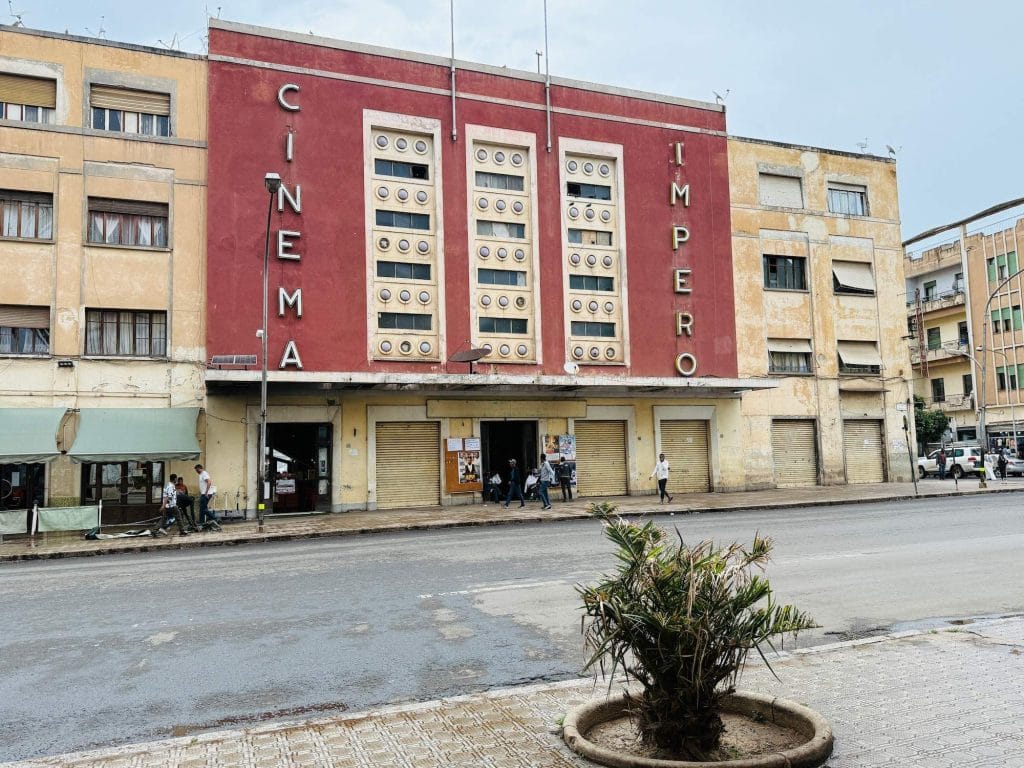
Cinema Impero & Cinema Roma
Cinema Impero (1937) is one of the finest surviving 1930s Art Deco cinemas in Africa, still showing films. Cinema Roma (Roma Theatre, 1920) is another landmark on Harnet Avenue. Even if you don't see a film, the exteriors alone are worth a photograph.
- 01
National Museum
The best introduction to Eritrean history: Aksumite artefacts, findings from the Adulis excavations, inscribed tombstones from the Dahlak Islands, Sabean materials, and an extensive weaponry collection from the 19th century. Opening hours vary and are best confirmed locally; your guide will check before you go. - 02
Medeber Market
Medeber is unlike any market you have been to. It is an open-air workshop where everything, oil drums, car axles, old exhaust pipes, is recycled into useful objects by hand. Tinkers, blacksmiths, and cobblers work in the open. The sound and smell of metalwork fills the air. One of Asmara's most memorable corners. - 03
Coffee Ceremony & Macchiato Culture
Asmara runs on macchiato. The coffee culture left by 50 years of Italian occupation is alive and thriving, the macchiato here rivals anything in Rome. A full traditional coffee ceremony (roasting, brewing, three rounds) takes 45 minutes and is one of the best cultural experiences Eritrea offers. Ask your guide to arrange one.

- 01
Tank Graveyard
On the outskirts of Asmara, thousands of Soviet-supplied tanks, armoured vehicles and artillery pieces, along with aircraft wreckage, lie open in a vast field with no fences and no signs. A raw and arresting reminder of the 30-year war that ended in 1991. Visit with your guide, and always ask before photographing: military equipment is a sensitive subject in Eritrea and photography restrictions apply. - 02
Asmara Brewery
Founded by the Italian entrepreneur Luigi Melotti and brewing since 1939, the Asmara Brewery is among the oldest working breweries in Africa and still produces Asmara Beer on its original Italian equipment. Tours can sometimes be arranged in advance, so ask us before you travel. The Asmara lager is genuinely good: one of the unexpected pleasures of the city.
The Drive: Asmara to Massawa
The 115 km road between Asmara and Massawa is one of the great drives in East Africa. It follows the route of the Eritrean rack railway built by the Italians between 1887 and 1911, descending 2,325 m over two and a half to three hours through more than 100 hairpin turns, volcanic escarpment, and desert gorges. The temperature rises 20°C by the time you reach sea level. Stop at Nefasit (1930s Italian railway station), Ghindea (fresh fruit and juice), and the Sycamore Valley overlook.

Things to Do in Massawa
On a tour of Asmara and Massawa, the Red Sea port city is the other great chapter. Massawa has been a major port for over a thousand years, occupied by the Portuguese, Ottomans, Egyptians, British, and Italians in turn, each leaving architectural traces in coral stone, plaster, and timber. The old town on Massawa Island is a UNESCO-quality labyrinth most visitors walk for hours without a plan. Neighbouring Taulud Island, joined by causeways, holds the Imperial Palace.

Masjid al-Sahaba: Africa's Oldest Mosque
Masjid al-Sahaba (Mosque of the Companions) on Massawa Island dates to 616 AD, when the first Muslim refugees from Mecca arrived on the Eritrean coast. Inscriptions inside mark it as one of the earliest mosques in the world. Open to respectful visitors outside prayer times.

The Old Town Alleyways
The best thing to do in Massawa is walk without a plan. The old town on Massawa Island is a maze of arched alleyways, coral-block houses, covered bazaars, and Ottoman-era mansions with carved wooden screens. Buildings are crumbling into beautiful ruin; some have been partially restored. The light in the late afternoon is extraordinary.

Imperial Palace & War Memorial
The ruined Imperial Palace (originally built 1872) served as Emperor Haile Selassie's Red Sea residence until it was damaged in the 1990 battle for Massawa. Its bullet-holed walls and sea views make it one of the most haunting stops in the city. Nearby, the War Memorial with three captured Ethiopian tanks commemorates the 1991 liberation.

- 01
Green Island Boat Trip
Green Island (Isola Verde) is 15 minutes by motorboat from Massawa, the most accessible point of the Dahlak Archipelago. White sand beach, mangrove swamp, and shallow-water coral for snorkelling. On any tour of Asmara and Massawa that includes a second night in Massawa, Green Island is the obvious morning activity before the drive back. - 02
Seafood in Massawa
The freshest Red Sea fish in Eritrea is served in Massawa. Grilled grouper, tilapia, and reef fish at the seafront restaurants, accompanied by injera or rice. The market near the port sells fish straight off the boat in the early morning. Budget $8–15 for a full meal with drinks.
Tour of Asmara and Massawa: Practical Information
All travel outside Asmara in Eritrea requires a government travel permit. We arrange all permits on your behalf when you book a guided tour. Independent visitors can apply via their tour operator in Asmara. See our complete Eritrea visa and permit guide for full details.
Getting between cities: Remember that all travel outside Asmara requires a government travel permit, and permits are issued against a named vehicle and licensed guide, so a private transfer arranged through us is normally the only practical option. Local shared minibuses do run the route, but they are not an alternative to the permit requirement. Best time to visit Massawa: October to March, when coastal temperatures are 26–32°C. Avoid June–August (40°C+). Money: No ATMs in Eritrea, bring all the cash you need in USD or EUR.
FAQ: Tour of Asmara and Massawa
- 01
How many days do I need for a tour of Asmara and Massawa?
A minimum of 3 days (1.5 days Asmara, 1.5 days Massawa + Green Island) is workable but rushed. Our recommended options are the 3-day Asmara & Massawa essentials (if time is tight) or the 6-day classic tour which also includes Keren's camel market and allows proper time at each site. Most visitors who come for a tour of Asmara and Massawa wish they had booked more days. - 02
Is Massawa safe to visit?
Massawa is a calm, low-crime city and our travellers walk the old town without trouble. The main practical challenge is the heat, so visit between October and March. Take normal precautions after dark, as parts of the old town are poorly lit, and your guide will advise on the day. We always provide a licensed local guide for all sites, and we would encourage you to check your own government's current travel advice before you book. - 03
Can I visit Massawa independently without a tour?
The Massawa permit can theoretically be arranged independently in Asmara, but it requires a licensed guide and private vehicle, which are exactly what our tours include. There is no practical advantage to going independently; the permit bureaucracy is easier to navigate through a local operator. Contact us for a no-obligation quote.