
The Eritrean Railway: Africa’s Last Working Steam Train and Living Heritage
Everything you need to know about the Eritrean Railway in 2026: Sunday schedule, ticket prices, how to book, history, and tips for riding the vintage steam train from Asmara.
Few travel experiences on Earth feel as genuinely suspended in time as riding the Eritrean Railway. Built by Italian colonial engineers between 1887 and 1932, this narrow-gauge line climbs more than 2,400 metres from the scorching Red Sea port of Massawa to the cool highland capital of Asmara, passing through 39 tunnels, over 65 bridges, and around breathtaking escarpments in just 118 kilometres. The same 1938 Ansaldo Mallet steam locomotives that hauled cargo during the Second World War still power the journey today. This is not a museum replica. This is Africa's last working historical steam railway, one of the most extraordinary things you can do anywhere on the continent.

Table of Contents
- Why Ride the Eritrean Railway?
- The Steam Train of Eritrea: A History Worth Knowing
- Engineering Marvel: How the Railway Climbs 2,400 Metres
- The Rolling Stock: Locomotives and Carriages
- What the Eritrean Railway Ride Is Really Like
- 2026 Schedule & Departure Details
- How to Book a Ride on the Eritrean Steam Train
- The Asmara Railway Museum
- The Eritrean Railway and UNESCO Heritage
- How Does It Compare to Other Heritage Railways?
- Will the Eritrean Railway Still Exist in 2030?
- Practical Tips Before You Board
- Final Thoughts
- Frequently Asked Questions
Why Ride the Eritrean Railway?
The short answer: because it is unlike anything else in Africa. The Eritrean Railway is not a polished tourist train with air-conditioning and recorded announcements. It is raw, authentic, and beautifully imperfect. You will ride in wooden carriages from the 1930s, lean out of open windows to photograph the dramatic landscape, and talk with local crew members whose families have worked on this railway for generations.
For railway enthusiasts, or ferroequinologists, to use the specialist term, the Eritrean Railway is a pilgrimage. For casual travellers, it is a highlight of any visit to Eritrea. And for photographers, the combination of vintage steam locomotives, dramatic mountain scenery, and golden highland light is absolutely dreamy.

The Steam Train of Eritrea: A History Worth Knowing
Understanding the railway's history transforms the ride. What looks like a charming heritage experience is actually the product of extraordinary engineering, devastating war, and one of the most inspiring acts of national restoration in African history.
Italian Colonial Era: Building Africa's Most Ambitious Railway (1887–1932)
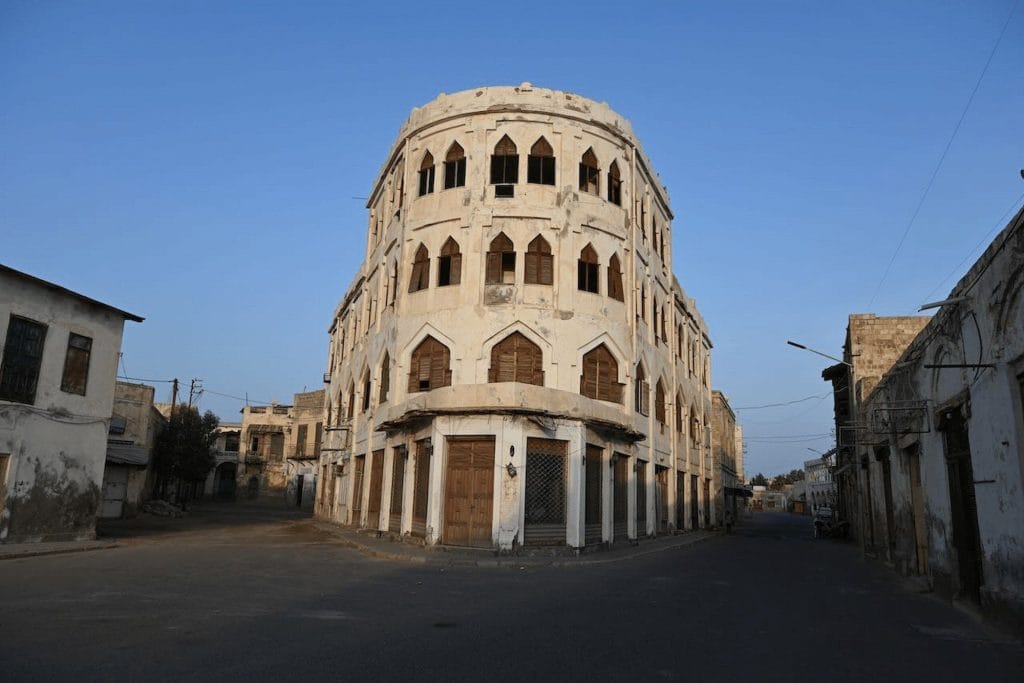
Construction began in autumn 1887 from the Red Sea port of Massawa. The challenge was immense: engineers needed to raise a railway from sea level to over 2,300 metres through volcanic rock, over chasms, and around sheer escarpments. The solution was a narrow-gauge track of just 950 millimetres (about 3 feet wide), combined with 39 tunnels and 65 bridges, including a dramatic 14-arch viaduct over the Obel River. The full technical history of the line is documented on the Eritrean Railway Wikipedia page.
The line reached Asmara in 1911, Keren in 1922, Agordat in 1928, and extended all the way to Bisha by 1932, a total original length of 337 kilometres. For its era, this narrow-gauge railway across Eritrea's terrain was a feat of engineering comparable to the Darjeeling Himalayan Railway or the mountain railways of the Andes.
- 01
Peak Years: Half a Million Passengers a Year (1935–1965)
At its height, the Eritrean Railway was the commercial artery of the country. By 1935, it was running 30 trains per day, a staggering level of operation given the difficult terrain. By 1965, it was carrying nearly 500,000 passengers annually and over 200,000 tonnes of freight. Salt, coffee, textiles, and people moved along this narrow-gauge line as a matter of daily life. - 02
Destruction During the War of Independence (1975–1991)
Then came war. The long Eritrean War of Independence (1961–1991) degraded the network year by year. In 1975, the Derg regime systematically destroyed what remained: tracks were ripped up, bridges blown, and locomotives dismantled or looted. Steel sleepers from the Eritrean Railway were even welded into military bunkers on the front lines. The railway that had taken 45 years to build was gone in months. - 03
The Veterans Who Rebuilt It: Pure Self-Reliance (1996–2003)
After Eritrea gained independence in 1993, restoring the Eritrean Railway became a national priority. What followed is one of the most remarkable railway restoration stories in the world. In 1996, a team of ageing Eritrean engineers, men in their 70s and 80s who had operated the original line in its 1960s heyday, volunteered to rebuild it themselves. Without foreign loans, without modern equipment, using only self-reliance and institutional memory, they dismantled damaged Mallet locomotives, rebuilt them from salvaged parts, relaid sleepers, and cleared the track metre by metre. By 2003, against extraordinary odds, the Massawa–Asmara section was operational again. The world's railway press called it one of the most inspiring restorations ever undertaken.
Engineering Marvel: How the Railway Climbs 2,400 Metres
The Eritrean Railway is not merely a tourist attraction: it is one of the most audacious feats of railway engineering ever completed. A conventional railway cannot handle gradients steeper than around 3–4%, yet Italian engineers needed to climb from a sea-level port to a highland city over 2,000 metres above it. Their solution: a route of breathtaking complexity, with switchbacks where the train reverses direction to gain height, sweeping curves, stone viaducts clinging to cliff faces, and 39 tunnels bored through solid volcanic rock. At its steepest, the gradient reaches 3.5%, the upper limit of what a steam locomotive can manage.
Switchbacks, Viaducts, and 39 Tunnels: A Technical Overview
The famous switchback you will experience on the tourist charter is the clearest illustration of the engineers' ingenuity. Unable to take a direct line up the escarpment, they designed a section where the train climbs in one direction, reverses onto a higher siding, then continues forward in the opposite direction, gaining altitude in a controlled zig-zag. Above this section, the narrow-gauge line clings to the mountainside for several kilometres, with the land dropping precipitously below. On the full original route, there were 65 bridges including a 14-arch stone viaduct, and 39 tunnels with the longest measuring 320 metres, cut through solid basalt by hand over decades of construction.

Route Map and Key Stations
The Rolling Stock: Locomotives and Carriages Still in Use Today
What makes the Eritrean Railway globally unique is not just its history: it is the fact that the original rolling stock is still in active service. This is extraordinarily rare anywhere in the world outside dedicated heritage museums.
- 01
The 1938 Ansaldo Mallet Steam Locomotives
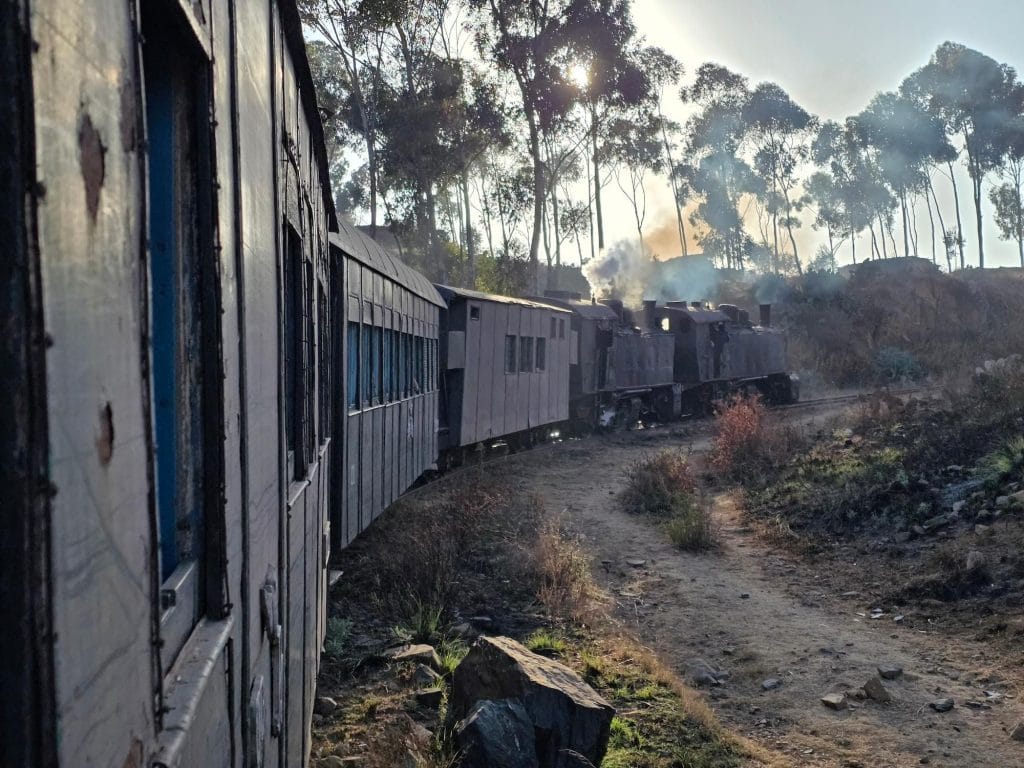
The stars of the show are the Class 0-4-4-0T Mallet articulated steam locomotives, built by Ansaldo in Genova, Italy, in 1938. The Mallet design, with two sets of driving wheels on separate frames that pivot independently, was specifically chosen for its ability to navigate the Eritrean Railway's tight mountain curves. At least two of these engines remain serviceable, maintained by a small team of Eritrean engineers. On the steepest sections above Asmara, the train runs double-headed: two locomotives working together. The deep, rhythmic exhaust note as they climb echoes across the highland valleys and is, for many visitors, the defining sound of their entire Eritrea journey. - 02
The 1935 Littorina Diesel Railcars
Alongside the steam locomotives, the railway also possesses vintage Italian Littorina diesel railcars from 1935. Their streamlined Art Deco design reflects the modernist aesthetic of 1930s Italian industrial design, entirely in keeping with Asmara's UNESCO-listed architecture. The Littorina railcars are used for smaller groups or specific private charters. Seeing one running through the Eritrean highlands is a remarkable sight: genuinely rare functional Art Deco rolling stock in active service. - 03
Original 1911 Passenger Coaches
Even the passenger carriages are originals, built in Milan in 1911. In a detail that delights railway enthusiasts: the coaches still use a brakeman who manually applies the brakes on each individual wagon during descent, exactly as they did over a century ago. On the Eritrean Railway, the word "vintage" is not a marketing choice. It is simply the way things are.
What the Eritrean Railway Ride Is Really Like
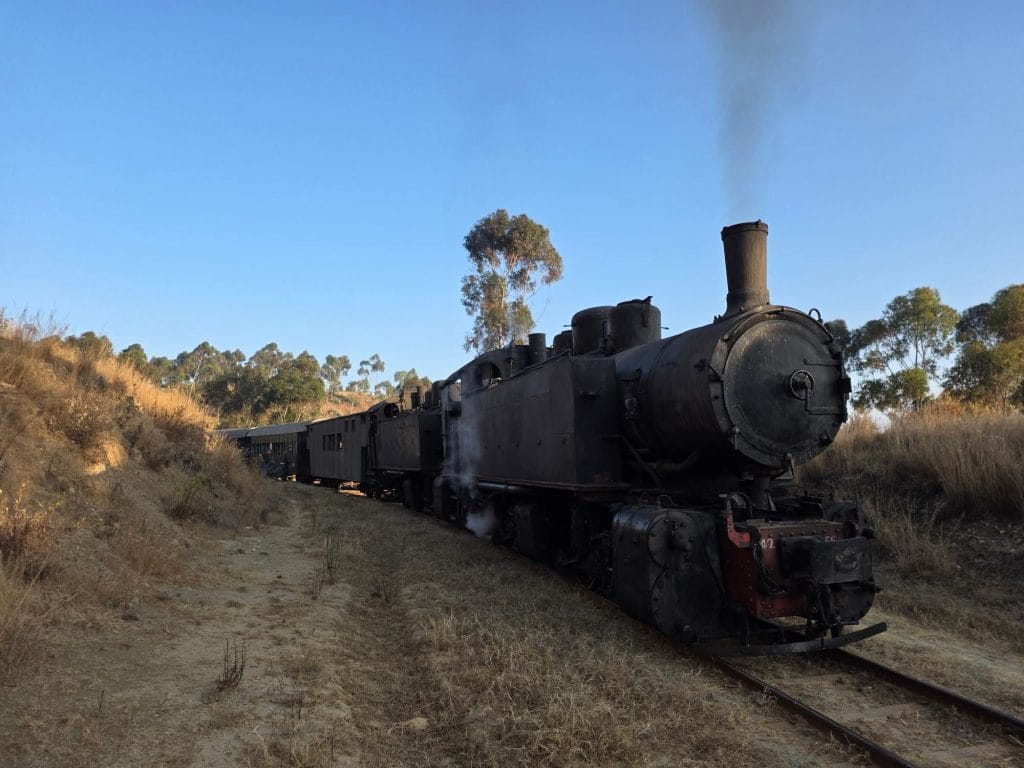
You arrive at Asmara Railway Station on Liberation Avenue, Italian colonial architecture, faded but beautiful. The steam locomotive is already hissing, smoke drifting into the cool morning air. At exactly 9:00 AM the whistle blows. The train lurches forward, slowly at first, then with more purpose. Within minutes, you are leaving Asmara behind and climbing into the highlands.
Around 9:45 AM you reach the famous switchback. The Eritrean Railway stops, and you can get out to watch the locomotive manoeuvre: it is a fascinating mechanical ballet to see how the engineers conquered the steep gradient. This is also your first great photo opportunity, with the train curving below you against the highland backdrop.
The most dramatic section comes after the switchback. The train snakes along mountainsides with vertiginous drops and terraced fields below. At Arberebu, the turnaround point, you watch the locomotive detach, run around the train on a separate loop track, and reattach for the return journey. You have about 20 minutes here to stretch your legs, take photos, and simply enjoy the silence of the highlands. The return trip brings you back to Asmara around 1:00 PM. It is not a luxury experience. The carriages are basic, the ride is bumpy, and you will get coal dust on your clothes. That is exactly why it is wonderful.

The Coffee Ceremony Stop at Arberebu
At the Arberebu turnaround, some tour configurations include a traditional Eritrean coffee ceremony: beans roasted fresh over charcoal, ground and brewed slowly, served in small cups with incense burning alongside. If yours includes it, accept it. It is the perfect counterpoint to the mechanical spectacle of the locomotive, the oldest Eritrean ritual meeting one of the oldest pieces of working technology on the continent, at the end of a highland track that should no longer exist.

Photography Guide: Best Shots on the Eritrean Railway
Before departure (8:15–9:00 AM): The steam locomotive at rest with pressure building is your first great subject. Get low: wheels, undercarriage, and hissing steam photograph beautifully in cool morning light. Arrive by 8:15 AM for the best angles before other passengers board.
The switchback (approx. 9:45 AM): Walk uphill above the track when the train stops. From there you can photograph the entire locomotive and carriages curving below against the highland backdrop, the classic Eritrean Railway shot. A 70–200mm lens is ideal.
Mountain section (10:00–11:00 AM): The stretch between the switchback and Arberebu is the most dramatic. The narrow-gauge train clings to the mountainside with vertiginous drops below. Shoot from open windows or stand between carriages for unobstructed views.
Arberebu run-around (approx. 11:30 AM): Watch and photograph the locomotive detaching, running the loop track, and reattaching at the other end. Stay close to the engine for this: it is the mechanical highlight of the day.
🗓 2026 Schedule & Departure Details
Here is what you need to know for the 2026 season:
- 01Operating days:Available on any day of the week (always operates as a chartered ride)
- 02Departure time:9:00 AM (please arrive at least 30 minutes early).
- 03Meeting point:Asmara Railway Station, Liberation Avenue, central Asmara.
- 04Route:Asmara to Arberebu and return to Asmara
- 05Total distance:Approximately 32 km round trip.
- 06Duration:Approximately 4–5 hours, including photo stops at scenic viewpoints.
How to Book a Ride on the Eritrean Steam Train
Booking a ride on the Eritrean Railway requires advance planning: this is not a service you can simply turn up and join. Here is everything you need to know.
- 01
Who Operates the Railway?
The railway is operated by the Eritrean Railway Corporation (ERC), a government body. Tourist rides are provided on a charter basis: the entire train is hired for your group rather than individual seats being sold. As authorised ERC partners, Adulis Travel handles all logistics on your behalf. - 02
Charter vs. Group Tour: Which Is Right for You?
The most practical way to ride the Eritrean Railway as a foreign visitor is through an Eritrea-specialist tour operator with an established ERC relationship. This simplifies booking, locomotive preparation (which requires several days' notice), and any required permissions. Independent travellers can contact the ERC directly through local representatives in Asmara, but this requires significantly more lead time and local knowledge. - 03
What Does It Cost?
Because the Eritrean Railway operates on a charter basis, the cost of hiring the locomotive and crew is shared across the travelling group. Larger groups are significantly more economical per person. Please contact Adulis Travel directly for current pricing: rates vary by season and group size. - 04
How Far in Advance Should You Book?
A minimum of 3–7 days' advance notice is needed to allow the railway crew adequate time to prepare the locomotive. For visits around Eritrean National Day (May 24th), when demand is highest and Asmara is particularly festive, booking 2–3 months in advance is strongly recommended.
Pickup Information
- 01All tour packages from Adulis Travel include hotel pickup. We collect you from your hotel in Asmara and take you directly to the station.
- 02If you only book the train ride:Hotel pickup is not automatically included, but you can add it as an extra service when you book.
Asmara is a safe and walkable city, and the railway station is centrally located on Liberation Avenue. If you prefer to make your own way, a taxi from most hotels in Asmara to the station costs just a few dollars.
The Asmara Railway Museum: A Must-Visit Addition
Adjacent to Asmara's beautifully preserved Italian colonial railway station, itself a masterpiece of early 20th-century modernist design, the Asmara Railway Museum provides the perfect context for your steam train experience. The museum houses vintage locomotives, period photographs, engineering drawings, and artefacts chronicling over 130 years of railway history in Eritrea.

For railway enthusiasts, the museum provides essential background on the technical challenges overcome during construction and the extraordinary restoration. For general visitors, it brings the human story to life: the Italian engineers, the Eritrean workers, the wartime destruction, and the veterans who refused to let the Eritrean Railway die. Entry is typically included in chartered railway tours, ask at your hotel in Asmara for current opening hours if you wish to visit independently.
The Eritrean Railway and Asmara's UNESCO World Heritage Status
In 2017, Asmara was inscribed on the UNESCO World Heritage List as Asmara: A Modernist City of Africa, one of the finest collections of early 20th-century Italian colonial architecture in the world. The Asmara Railway Station and its associated workshops are integral components of this heritage landscape. Designed in the rationalist modernist idiom of 1930s Italy, the station building features the same clean lines, geometric forms, and monumental proportions found throughout Asmara's famous streetscapes, which Italian architectural historians called Piccola Roma, Little Rome.
Riding the Eritrean Railway is therefore not just a journey through dramatic mountain scenery: it is a journey through a UNESCO World Heritage site, past buildings and engineering structures that represent a unique and complex chapter in both African and Italian history. When you board at Asmara station, you are standing inside one of the most architecturally significant railway buildings on the continent.
How Does the Eritrean Railway Compare to Other Heritage Railways?
Railway specialists compare the Eritrean Railway directly to the Darjeeling Himalayan Railway in India (a UNESCO World Heritage Site), the Semmering Railway in Austria, and the mountain railways of the Andes, all narrow-gauge lines climbing vertiginous terrain using Victorian-era engineering. What sets the Eritrean Railway apart: unlike those lines, which have received substantial modern investment, the Eritrean Railway operates essentially as it did a century ago: same locomotives, same carriages, same manual brakemen on the wagons. That raw authenticity is precisely what draws heritage railway enthusiasts from across the world.
Will the Eritrean Railway Still Exist in 2030?
We need to be honest with you: the Eritrean Railway's future is uncertain.
The original route ran 118 km from Asmara all the way down to the Red Sea port of Massawa. Today only the Asmara–Arberebu section, approximately 32 km round trip, operates for tourist charters. Over the years the active endpoint has progressively moved closer to Asmara: from Massawa, to Nefasit, and now to Arberebu. Without investment in track restoration it may move again.
The locomotives are maintained by a small, dedicated team. Parts are increasingly difficult to source. Some of the veteran engineers who rebuilt the line from memory after independence have already passed away. None of this is certain doom: the Eritrean government has shown it can achieve extraordinary things with this railway when it commits, and growing international tourism interest creates economic incentive to preserve it. But if riding the Eritrean steam train is on your list, this is not a trip to postpone indefinitely. The experience available in 2026 may not exist in 2030.
Practical Tips Before You Board
After riding the Eritrean Railway more times than we can count, here is our honest advice:
- 01Bring a camera with a zoom lens.The switchback shots from above are spectacular. A 70–200mm is ideal; bring a wide lens for the panoramas.
- 02Dress in layers.Mornings in Asmara are cool, around 12–15°C (54–59°F). By midday it warms up significantly. A light jacket or fleece is perfect.
- 03Don't forget sunscreen and a hat.Even at altitude, the Eritrean sun is intense, especially during the long stops.
- 04Bring extra water and a small snack.There are no shops at Arberebu, so pack everything you need for the 4–5 hour journey.
- 05If you are prone to motion sickness, take medication beforehand.The narrow-gauge track sways more than modern trains, especially on the mountain curves.
- 06Use the toilet at Asmara station before departure.There are no restrooms on the train, and facilities at Arberebu are limited.
- 07Accept that you will get a little dirty.Coal dust and vintage steam trains go together. Wear clothes you do not mind getting slightly sooty.
- 08Arrive by 8:30 AM.The train leaves promptly at 9:00 AM and will not wait for latecomers.
Final Thoughts: Why This Tourist Attraction Matters
The Eritrean Railway is more than a tourist attraction. It is a symbol of national resilience. After decades of war, when so much of the country's infrastructure lay in ruins, a small group of elderly engineers chose to rebuild, not because it made economic sense, but because some things are worth preserving for their beauty, their history, and the sheer joy they bring.
When you ride this railway, you become part of that story. You will feel it when the whistle echoes across the highlands at 9:00 AM, when you share a smile with a crew member, when you stand at Arberebu watching the locomotive run around its train and realise: this Eritrean Railway should have died. But it did not. And you are here to help make sure it does not.
Questions? Reach out to our team: we reply within hours.
More from the Adulis Travel blog:
Everything you need to know about getting a visa to Eritrea
Discovering the hidden treasures of Eritrea
Is Eritrea safe for tourists?
Travel to Somaliland: a complete guide
Adulis Travel is a local tour operator based in Asmara, Eritrea. We are authorized partners of the Eritrean Railway Corporation. All information verified for the 2026 season.
Frequently Asked Questions About the Eritrean Railway
Is the Eritrean Railway still running in 2026?
Yes, the Eritrean Railway is operational for tourist charters on the Asmara–Arberebu section (approximately 32 km round trip). It runs on demand, any day of the week, when booked in advance. It does not operate on a fixed public timetable.
What locomotive does the Eritrean Railway use?
The primary locomotives are 1938 Ansaldo Mallet articulated steam engines (type 0-4-4-0T), built in Genova, Italy. At least two are in working order. For some smaller group charters, the railway uses its 1930s Fiat Littorina Art Deco diesel railcars instead. The passenger coaches are original 1911 Milan-built carriages.
What time does the Eritrean steam train depart?
Departure is at 9:00 AM sharp from Asmara Railway Station, Liberation Avenue. Please arrive by 8:30 AM. The total journey takes approximately 4–5 hours, returning to Asmara around 1:00 PM.
How much does it cost to ride the Eritrean Railway?
The train operates on a full charter basis, so the cost is shared across the group. Booking with a group tour is the most cost-effective option. Contact Adulis Travel directly for current pricing: rates vary by season and group size.
How do I book a ride on the Eritrean steam train?
Rides must be booked in advance, at least 3–7 days before your preferred date, to allow the railway crew time to prepare the locomotive. The easiest way for international visitors is to book through Adulis Travel, an authorised Eritrean Railway Corporation partner. Contact us and we will handle everything.
Does the train still stop at Nefasit?
No. As of 2026, the route is direct from Asmara to Arberebu and back. The total round trip is approximately 32 km. There is no longer a stop in Nefasit. The journey still includes the famous switchbacks and mountain section.
What is the track gauge of the Eritrean Railway?
950 mm (3 feet 1.5 inches) narrow gauge, Italian standard for colonial light railways of the late 19th century. The narrow gauge was chosen because it handles tight mountain curves better than standard-gauge track.
What happened to the Eritrean Railway during the war?
During the Eritrean War of Independence (1961–1991), the railway was progressively destroyed. In 1975, the Derg regime systematically dismantled the line: tracks were ripped up, steel sleepers were repurposed as military fortifications, and locomotives were looted. The system had entirely ceased operating by the early 1990s. Restoration by Eritrean veterans began in 1996, and the Asmara–Massawa section reopened in 2003.
Is the Asmara railway station a UNESCO heritage site?
Yes. Asmara was inscribed on the UNESCO World Heritage List in 2017 as Asmara: A Modernist City of Africa. The railway station and its associated infrastructure are part of this inscription, recognised as outstanding examples of early 20th-century Italian modernist colonial architecture.
Is the train safe for children and families?
Absolutely. The pace is slow and family-friendly. Children are typically fascinated by the vintage steam locomotive. Just keep an eye on them near open windows or doors, and pack snacks and water for the 4–5 hour journey.
What is the best time of year to ride the Eritrean Railway?
The dry season (October to April) offers the clearest views and most reliable weather. The most atmospheric time is around Eritrean National Day (May 24th), when Asmara is particularly festive. The train runs year-round, but July–August can bring afternoon rain in the highlands.
Do I need a visa to visit Eritrea and ride the train?
Yes, most nationalities require a tourist visa for Eritrea. Adulis Travel can assist with visa arrangements as part of your tour booking. See our detailed Eritrea visa guide for requirements and application steps.
Planning more of your trip? See our Eritrea travel guide for tours, attractions and practical tips.
Plan your Eritrea trip with Adulis Travel
Read our complete Eritrea travel guide, browse related Eritrea tours, or request a private quote.
More Eritrea travel guides: Eritrea visa · is Eritrea safe? · attractions · Asmara · Massawa · Danakil · Asmara and Massawa · hiking around Asmara.