
Laas Geel: art that has survived 5,000 years
High on a granite outcrop near Hargeisa, the Laas Geel shelters hold some of the best-preserved rock art in Africa, vivid cattle, long-horned and ceremonial, painted millennia ago. Almost unknown to the wider world, they are a humbling reminder of how deep human history runs in the Horn.
An hour or so from Hargeisa, on a granite hill where two seasonal rivers meet, a cluster of shelters holds some of the best-preserved rock art in Africa, the oldest known in the Horn of Africa, and, because so few travellers reach Somaliland, one of the continent's least-visited archaeological sites.
Paintings older than the pyramids
The rock art of Laas Geel is around 5,000 years old. The French mission that surveyed the site dated the paintings to roughly 3500-2500 BCE, which means the oldest panels were made long before the first stones were laid at Giza. You will sometimes see tour brochures claim figures of 8,000 or even 11,000 years; those numbers come from marketing copy, not from the excavators, and we would rather give you the date the scholarship actually supports. Even at 5,000 years, Laas Geel is astonishing.
The name itself is Somali: laas means a well or water source and geel means camels, so Laas Geel is, roughly, "the camels' watering hole", a reminder that this granite outcrop has drawn herders and their animals to its shade and water for millennia.
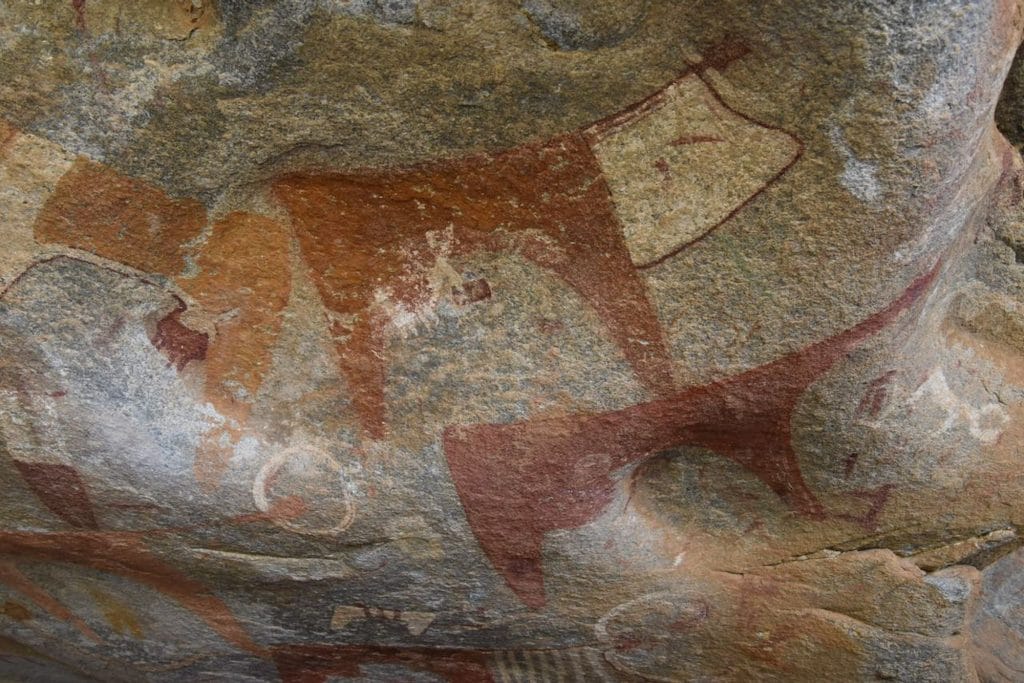
Painted in rich ochres, reds, yellows and whites, all natural mineral pigments, the panels are dominated by humpless long-horned cattle, many of them draped in what look like ceremonial collars and garments. Around them stand human figures with their arms flung wide, read by archaeologists as herders or worshippers; some cows are ringed with sunburst-like halos, and a cow-and-worshipper motif recurs across several shelters. There are dogs at the herders' heels, a giraffe, and other wild animals worked into the rock. Scholars regard these cattle-and-human scenes as some of the earliest cattle-cult imagery known in the Horn of Africa.
For the people who made them, cattle were clearly central to life and belief, a reminder that the pastoral cultures of the Horn run thousands of years deep. The art belongs to what specialists call the Ethiopian-Arabian tradition of the region, sharing its style with sites such as Dhambalin and Karinhegane, though the French team who studied Laas Geel considered its execution original and first-of-its-kind.
A site the world almost missed
Local Somali herders had known the painted shelters for generations, but Laas Geel was only formally documented in late 2002, when a French archaeological mission led by Xavier Gutherz of the Université Paul Valéry in Montpellier surveyed the area and recorded the alcoves in early December. The team returned in 2003 and 2004 for detailed study, and their work is why the site is dated as confidently as it is today.
The paintings are scattered across around twenty granite shelters and alcoves set into the hill on several levels, the largest of them roughly ten metres long. Their survival is remarkable, and there are good reasons for it: the overhanging granite has shielded the pigments from sun and rain, the climate here is dry, and the site's remoteness has kept visitor numbers low. Because Somaliland sits outside the usual tourist map, the paintings have escaped the crowds and the wear that have marked far better-known rock-art sites, on most days you may well have the shelters almost entirely to yourself.

Why it isn't a World Heritage Site
Few archaeologists doubt that Laas Geel would already carry a UNESCO World Heritage listing were it almost anywhere else. The obstacle is political rather than academic. UNESCO can only inscribe sites nominated by a recognised state party, and because Somaliland is not internationally recognised, it cannot submit a nomination of its own. Somalia, which does hold that seat, does not administer the site. UNESCO conservation experts have visited, but no inscription has followed. It is one of the quiet ironies of the place: a monument of world importance, kept off the world's official list by a question of borders.
Visiting with care
Reaching Laas Geel is straightforward with the right arrangements. The site lies about 50 km northeast of Hargeisa, along the main road towards the coral port of Berbera; the drive takes an hour or so, with a short walk up to the shelters at the end. Travel outside Hargeisa in Somaliland requires a permit from the Ministry of Tourism and, by law, an armed SPU (Special Protection Unit) escort travelling with your vehicle, a rule in place since the early 2000s. We handle the permit, the local Somali driver-guide and the escort as part of the trip, so the logistics stay invisible to you.
At the site a local caretaker points out the motifs shelter by shelter. Photography is welcome; touching the paintings is strictly forbidden, and quite rightly, the pigments have lasted five thousand years precisely because so few hands have reached them. Around the granite country you may spot hamadryas baboons, the Horn's native species, moving across the slopes and along the approach road.
Access by permit and guide both protects the art and channels support to the communities who safeguard it. Our Somaliland itineraries pair Laas Geel with the colourful markets of Hargeisa and the Ottoman-era coral port of Berbera on the Gulf of Aden, so the rock art sits within a fuller picture of the country rather than as a single stop.

Frequently asked questions
How old is the rock art at Laas Geel? It is around 5,000 years old. The French mission that surveyed the site dated the paintings to roughly 3500-2500 BCE, which puts the oldest panels well before the pyramids of Giza. Higher figures such as 11,000 years appear in tour brochures but are not supported by the scholarship.
What does "Laas Geel" mean? It comes from Somali: laas means a well or water source and geel means camels, so the name translates roughly as "the camels' watering hole."
Who discovered Laas Geel? Local herders had long known the shelters, but the site was formally documented in late 2002 by a French archaeological mission led by Xavier Gutherz, with detailed study following in 2003 and 2004.
Is Laas Geel a UNESCO World Heritage Site? No. Because Somaliland is not internationally recognised, it cannot submit a UNESCO nomination, so the site remains uninscribed despite being widely considered of World Heritage calibre.
How do you get to Laas Geel from Hargeisa? It is about 50 km northeast of Hargeisa on the road towards Berbera, roughly an hour's drive, followed by a short walk up to the shelters. A tourism permit and an armed SPU escort are required for the trip.
Can you take photographs at Laas Geel? Yes, photography is permitted, but touching the paintings is strictly forbidden in order to preserve the pigments.
See Laas Geel with Adulis Travel
Visit the Laas Geel cave paintings on our 3-day Somaliland tour or combined Somaliland & Somalia journey, or request a private quote.
More guides: Somaliland travel guide · is Somaliland safe?.